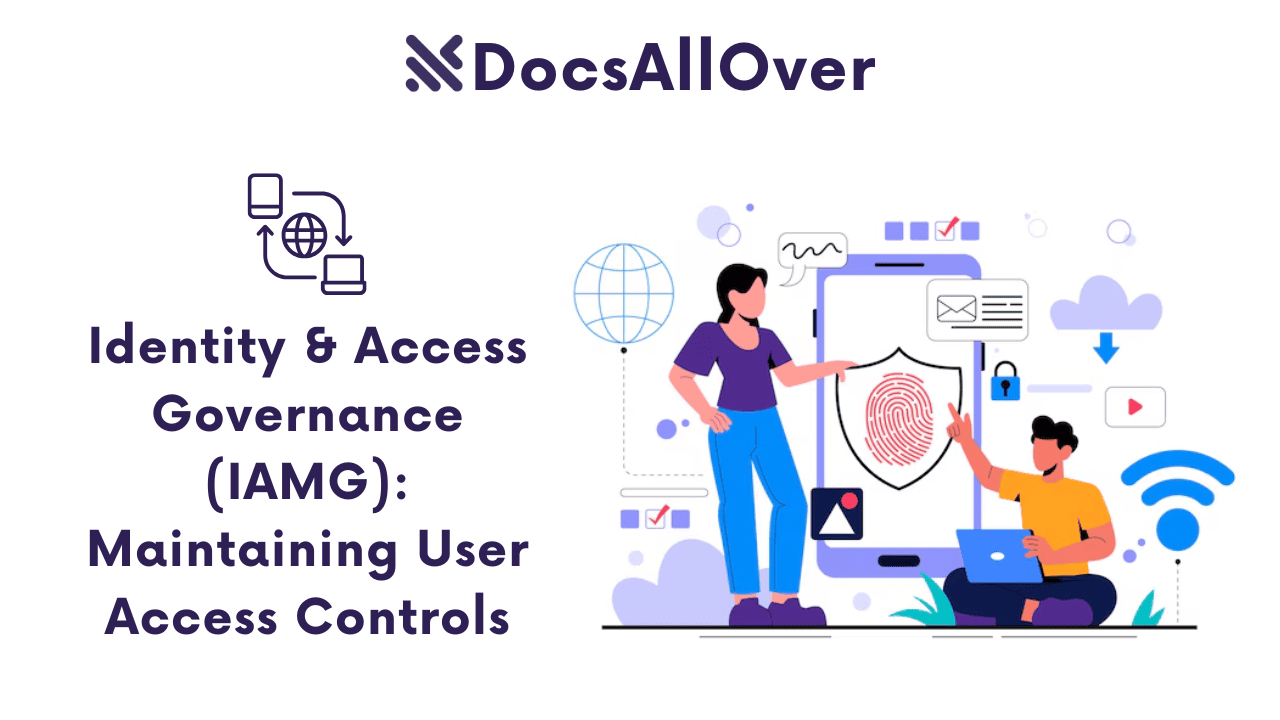
Identity and Access Management Governance (IAMG): Maintaining User Access Controls
The modern enterprise is an ecosystem of countless applications, cloud services, and complex data environments. For every employee, contractor, or partner, IT administrators face the daunting task of granting the correct permissions to dozens or even hundreds of systems. This often leads to "access sprawl," where users accumulate more permissions than they need over time. The result is a dangerous risk landscape filled with excessive permissions and "toxic combinations"—sets of access rights that, when held by a single person, could allow for fraud or critical data breaches. Compounding this challenge are manual, error-prone processes that make it impossible to know precisely who has access to what.
This is the problem Identity and Access Governance (IAG) is designed to solve.
IAG is the strategic policy and process layer that sits above Identity and Access Management (IAM). While IAM focuses on the technical mechanisms of how access is granted (e.g., single sign-on, provisioning, authentication), IAG focuses on the crucial question of control:
- Who should have access?
- Why do they need it?
- For how long is it appropriate?
- When should that access be reviewed or revoked?
The goal of this post is to outline the essential components and best practices for implementing effective IAG. By focusing on governance, auditability, and control, you can secure sensitive data, eliminate excessive risk, and satisfy demanding regulatory requirements with confidence.
Core Pillars of Identity and Access Governance
Effective Identity and Access Governance (IAG) relies on three interconnected core pillars that establish a continuous, verifiable system of control over user access rights.
A. Identity Lifecycle Management
Identity Lifecycle Management (ILM) is the foundational process of managing a user's digital identity from the moment they enter the organization until they leave. This process is often referred to as the Joiner-Mover-Leaver (JML) cycle.
- Joiner: Automatically provision essential access when a new employee starts (e.g., email, standard applications) based on their job role.
- Mover: Automatically adjust or remove old access rights when an employee changes roles or departments, ensuring access is appropriate for the new function.
- Leaver: Automated deprovisioning is the most critical process. IAG ensures that an identity is immediately deactivated and all access is revoked upon termination or departure, thereby eliminating a major security risk (the terminated user vulnerability).
B. Access Certification/Recertification
Over time, users naturally accumulate access, leading to permission bloat. Access Certification, or recertification, is the periodic, formal process designed to combat this.
- Business managers (often the user's direct supervisor or the application owner) are required to review the current access rights of their staff or application users. They must then formally certify that all access is still necessary and appropriate.
- Importance:This process is critical for removing stale or excessive access rights—the continuous "access cleanup" that keeps the organization secure and compliant. It forces accountability back to the business owners who understand the true need for the permissions.
C. Access Request and Approval Workflow
When a user needs new access that is outside of their standard role, they must follow a structured Access Request and Approval Workflow.
- Users request access via a self-service portal, where the request is routed automatically to the appropriate business manager and/or application owner for review.
- Principle: This workflow is the primary mechanism for enforcing the Principle of Least Privilege. This security mandate dictates that a user should only be granted the minimum access rights necessary to perform their job functions and nothing more. The IAG system ensures that the request and approval are documented, auditable, and aligned with company policy.
Strategic Access Control Models
To maintain robust user access controls, IAG utilizes strategic access control models that define how permissions are structured and enforced across the enterprise.
A. Role-Based Access Control (RBAC)
Role-Based Access Control (RBAC) is the most common and foundational model in IAG.
- Concept: Instead of assigning individual permissions to every user (a one-to-one mapping), permissions are bundled and assigned to a Role. Users are then simply assigned to one or more Roles based on their job function. For instance, the "Financial Analyst" Role would contain permissions for financial reporting software and specific database access, and all Accountants would be assigned this single Role.
- Benefit: RBAC dramatically simplifies management and reduces administrative burden. It transforms potentially thousands of individual user-to-permission assignments into a manageable set of business-defined Roles, ensuring that access is consistent and predictable across the organization.
B. Policy-Based Access Control (PBAC) / Attribute-Based Access Control (ABAC)
As organizations adopt cloud-native architectures, the need for more granular, dynamic control increases, leading to the rise of Attribute-Based Access Control (ABAC), often implemented via Policy-Based Access Control (PBAC).
- Concept: Unlike RBAC, which is static, ABAC/PBAC grants access based on evaluating a set of dynamic attributes at the time of the request. These attributes can include the user's current location, the time of day, the security level of the resource, the user's project status, or their clearance level. A policy might state: "Allow access to confidential documents only if the user's job title is 'Director' AND the request is made during business hours AND the user is logging in from a corporate device."
- Benefit: ABAC/PBAC provides extremely granular control, making it highly suitable for modern, complex cloud environments, microservices, and securing APIs where access decisions need to be dynamic and context-aware.
IAG for Regulatory Compliance and Auditing
Identity and Access Governance is not merely a security best practice; it is a fundamental requirement for satisfying stringent regulatory mandates and successfully passing external audits.
The Need for Auditability
Regulators and external auditors (e.g., from bodies overseeing SOX, HIPAA, or GDPR) do not simply ask if you have security policies; they demand proof that your user access controls are robust, consistently enforced, and auditable. An effective IAG framework provides the comprehensive reports and historical logs necessary to demonstrate:
- Who has access to what data.
- When that access was granted.
- Who approved it.
- When the access was last certified as still necessary.
Key Compliance Drivers
IAG directly addresses the control requirements for major regulatory frameworks:
- SOX (Sarbanes-Oxley Act): This focuses heavily on the integrity of financial reporting. IAG ensures tight control over access to financial systems, databases, and general ledger accounts, which is critical for preventing fraudulent changes.
- HIPAA (Health Insurance Portability and Accountability Act): For healthcare organizations, IAG is essential for protecting access to Protected Health Information (PHI). It verifies that only authorized personnel (e.g., doctors, billing staff) can view sensitive patient data.
- GDPR (General Data Protection Regulation): IAG supports GDPR requirements by providing clear accountability for control over Personally Identifiable Information (PII) and ensuring that access can be revoked immediately if a user requests the right to be forgotten.
Segregation of Duties (SoD)
Segregation of Duties (SoD) is arguably the most critical control for financial and operational integrity within IAG.
- Concept: SoD prevents a single user from possessing two conflicting sets of permissions that, if combined, could be used to commit fraud or severe errors. A classic example is preventing one person from creating a vendor account AND approving payments to that same vendor.
- IAG Role: IAG systems are vital for SoD compliance. They have built-in rulesets that can automatically identify SoD violations the moment a user requests a conflicting permission. Furthermore, IAG can flag existing violations and initiate a remediation workflow, either by removing the conflicting access or requiring documented management approval for the exception (a "compensating control").
IAG Implementation Best Practices
Implementing a strong Identity and Access Governance (IAG) program requires a strategic shift from manual controls to automated, policy-driven processes. These best practices will ensure your IAG initiative is successful, scalable, and auditable.
1. Automate Everything
The foundation of modern IAG is automation. Relying on manual tickets, emails, or spreadsheets for granting and revoking access is inefficient, costly, and inherently insecure.
- Provisioning & Deprovisioning: Automatically create and grant baseline access when a user joins, and immediately revoke all access upon termination.
- Recertification Workflows: Use IAG tools to automatically generate, assign, and track certification campaigns, sending reminders and escalating non-responses.
Automation minimizes manual error, ensures near-instant access removal, and dramatically reduces operational costs.
2. Start with Roles, Not Tools
Before purchasing IAG software or configuring connectors, the most crucial step is to define your Role-Based Access Control (RBAC) model.
- Define Clear Roles: Work with business unit leaders to define a set of clear, non-overlapping Roles (e.g., "HR Administrator - US," "Sales Rep - West Coast") based on business function and least privilege principles.
- Model Access: Map the specific permissions and entitlements required for each role before technical implementation. A messy set of roles will lead to a messy, unmanageable IAG system later on.
3. Integrate with HR as the Authority
The accuracy and timeliness of IAG are directly dependent on the quality of identity data. The Human Resources (HR) system (the "source of truth") must be the authoritative source for all identity information.
- Authoritative Data: Integrate your IAG system directly with your HR platform (e.g., Workday, SAP SuccessFactors) to pull critical attributes like name, status (active/inactive), job title, and manager.
- Timely Deprovisioning: This integration ensures that the IAG system receives an immediate trigger when an employee's status changes to "terminated," allowing for automated deactivation of all accounts before an ex-employee leaves the building.
4. Comprehensive Reporting and Auditing
The value of IAG lies in its ability to prove compliance. Robust reporting is essential to satisfy auditors and provide transparency to the business.
- Compliance Readiness: Establish clear, recurring reports that answer key audit questions: "Who was certified for access to the financial system last quarter?" "What are the current Segregation of Duties (SoD) violations?"
- Historical Traceability: Maintain a complete, immutable audit trail of every access grant, modification, denial, and certification decision. This comprehensive history is the concrete proof you need to demonstrate that access controls are being maintained effectively.
We've seen that Identity and Access Governance (IAG) is far more than a technical IT solution; it is the strategic oversight layer essential for modern enterprise security. By implementing the core pillars—automated Identity Lifecycle Management, periodic Access Certification, and controlled Access Request Workflows—organizations can guarantee robust access security and protect sensitive data from both internal and external threats. Most importantly, IAG provides the comprehensive auditability required to meet crucial regulatory mandates like SOX, HIPAA, and GDPR, especially through critical controls like Segregation of Duties (SoD).
It is vital to recognize that IAG is not a one-time project but an ongoing, dynamic commitment. The risk landscape, employee roles, and compliance requirements are constantly evolving. A strong, automated IAG framework shifts security from being a costly, bureaucratic roadblock into a powerful business enabler that allows the organization to move quickly and securely.
To take the next step in securing your organization, we encourage you to review your current access certification process. Is it manual? Is it performed regularly? Does it cover all high-risk applications? Improving this single pillar is the fastest way to reduce accumulated risk and begin your journey toward comprehensive Identity and Access Governance.